Cutler Commentary
Q2-2025, Market Commentary
July 17, 2025
Cutler Market Commentary - 2nd Quarter 2025, Review and Outlook
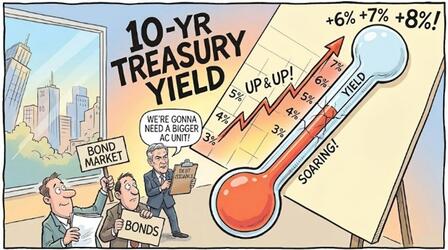
They say, “March comes in like a lion and out like a lamb.” Similarly, the second quarter came in like a Bear and out like a Bull. At the start of the quarter, on April 2nd, the markets were rattled by “Liberation Day.” Reciprocal tariffs, some of astonishingly high percentages such as a 46% rate on Vietnam or even a 37% rate on Liechtenstein, resulted in a steep market sell-off and the precipice of a bear market. (Bear markets are defined as a drop of 20% from the previous market highs). The day after the announcement, the S&P 500 fell 4.8% and the Nasdaq 100 had the biggest single point loss in history. Financial stress rapidly entered the US economy, and the US bond market sold off significantly. Clearly, this was unsustainable. By April 9th, the Wall Street Journal reported that Treasury Secretary Bessent was advocating to the President for a 90-day pause, which was agreed upon. After announcing the pause, the S&P 500 rallied a phenomenal 9.52% in a single day!
If the stock market expressed one opinion in Q2, it was resoundingly regarding tax policy. An aggressive tariff approach increases import taxes paid by American consumers. These taxes reduce economic activity and raise the cost of goods, and the Liberation Day market sell-off reflected that concern. However, that isn’t the end of the story. By the end of the quarter, taxes were having the opposite effect. The One Big Beautiful Bill, a bill with a decidedly lower-tax ethos, was poised to pass Congress before a self-imposed July 4th deadline. Lower taxes imply capital available to generate economic growth and to purchase investment assets, and the market moves reflected the changing tax sentiment during the quarter. Stocks rallied to close Q2, finishing the first half of the year up by 6.2%. Shortly thereafter, the S&P 500 returned to an all-time high! The Bloomberg Aggregate was up 4%. And volatility, as measured by the VIX, was below the pre-Liberation Day levels! Stocks headed into the third quarter with a lot of positive momentum.
But that isn’t the full story. Growth stock momentum, such as the Magnificent 7 trade, has dominated returns in recent years. With the market sell-off, we saw Value stocks (with their lower valuations) hold up better overall than Growth. That trade reversed in a big way, as momentum stocks dominated the quarter. The Russell 1000 Growth finished Q2 up 17.84% for the period. Wow. The Russell 1000 Value? A quarterly return of just 3.79% (still not bad!). Interestingly, these assets finished the first half nearly identical in overall performance – Growth was up 6.09% and Value 6.02%.
Another piece of the story? International investments. Much hullabaloo was made about the demise of the dollar and the flight of international assets due to current economic instability. These views were largely substantiated by the drop in the dollar, with its worst first half loss in over 50 years. The Euro rallied 12.5% and the Yen 8% in the first six months of the year. This led to some eye-popping international returns. The MSCI EAFE index, a measure of developed country stocks, was up 19.92% in the first half of the year. Gold, often seen as a currency alternative, has been the standout asset of the year – up 25.67% on a year-to-date basis. It is worth noting that despite the losses in the dollar, the long-term trend for the global reserve currency has been strong. Cutler has advocated exposure to international for quite some time, not necessarily because of a currency hedge, but largely due to a valuation gap with more expensive US equities. As we proceed through the second half of the year, we will be looking for positive catalysts. Will the OBBBA lead to accelerated growth expectations? Or, has the lower tax policy been largely priced in? Will we see a resurgence of tariff wars, with the 90-day deadline having passed? Or will the Administration soften the rhetoric after experiencing the Q2 volatility? How will earnings per share growth support today’s elevated market valuations?
Our answer to these questions remains grounded by our investment principles. We believe that market timing, trying to predict when the stock market will go up or down, does more harm than good. Instead, stay rooted in your strategy and to your risk positioning. We believe that quality, measured by dividends and cash flows, can lead to reduced portfolio volatility. And we believe that diversification can help to reduce the impact of being wrong. For today’s investors, there is a reasonable amount of risk associated with uncertainties to trade and slowing global and domestic growth. While these risks might be reason for investors to pause, long-term investors are almost always best suited to ignore them and remain focused on your investment goals.
Past performance is not indicative of future results. Strategies referenced herein may be materially different than actual positions held in client accounts. Different types of investments involve varying degrees of risk, and there can be no assurance that any specific investment or strategy will be profitable or suitable for a particular investor's financial situation or risk tolerance. Investing involves risk, including loss of principal. You cannot invest directly in an index. Nothing herein should be considered a recommendation to buy or sell a security, including any securities, mutual funds, or ETFs specifically provided as examples. Asset allocation and portfolio diversification cannot assure or guarantee better performance and cannot eliminate the risk of investment losses. Neither Cutler Investment Counsel, LLC nor its information providers are responsible for any damages or losses arising from any use of this information.
The S&P 500 Index is widely regarded as the best single gauge of large-cap U.S. equities. The index includes 500 leading companies and captures approximately 80% coverage of available market capitalization.
The Barclay’s Aggregate Bond Index (Taxable Bond) is a broad base, market capitalization weighted bond market index
representing intermediate term investment grade bonds traded in the United States.
Headline Inflation is the raw inflation figure reported through the Consumer Price Index (CPI) that is released monthly by the Bureau of Labor Statistics.
The Bloomberg Commodity Index (Commodities) is an index of the prices of items such as wheat, corn, soybeans, coffee, sugar, cocoa, hogs, cotton, cattle, oil, natural gas, aluminum, copper, lead, nickel, zinc, gold and silver. The index is calculated on an excess return basis and reflects commodity futures price movements.
The MSCI EAFE Index (Foreign Developed Index) is designed to represent the performance of large and mid-cap securities across 21 developed markets, including countries in Europe, Australasia and the Far East, excluding the U.S. and Canada.
The MSCI Emerging Markets Index captures large and mid-cap representation across 27 Emerging Markets (EM) countries. With 1,392 constituents, the index covers approximately 85% of the free float-adjusted market capitalization in each country.
Bitcoin Each crypto index is made up of a selection of cryptocurrencies, grouped together and weighted by market capitalization (market cap). The market cap of a cryptocurrency is calculated by multiplying the number of units of a specific coin by its current market value against the US dollar.
Source: Morningstar All opinions and data included in this commentary are as of June 30, 2025 and are subject to change. The opinions and views expressed herein are of Cutler Investment Counsel, LLC and are not intended to be a forecast of future events, a guarantee of future results or investment advice. This report is provided for informational purposes only and should not be considered a recommendation or solicitation to purchase securities. This information should not be used as the sole basis to make any investment decision. The statistics have been obtained from sources believed to be reliable, but the accuracy and completeness of this information cannot be guaranteed.
Tags: global market, volatility, financial planning, gifting, taxation
CATEGORIES


Disclaimer
These blogs are provided for informational purposes only and represent Cutler Investment Group’s (“Cutler”) views as of the date of posting. Such views are subject to change at any point without notice. The information in the blogs should not be considered investment advice or a recommendation to buy or sell any types of securities. Some of the information provided has been obtained from third party sources believed to be reliable but such information is not guaranteed. Cutler has not taken into account the investment objectives, financial situation or particular needs of any individual investor. There is a risk of loss from an investment in securities, including the risk of loss of principal. Different types of investments involve varying degrees of risk, and there can be no assurance that any specific investment will be profitable or suitable for a particular investor's financial situation or risk tolerance. Any forward looking statements or forecasts are based on assumptions and actual results are expected to vary. No reliance should be placed on, and no guarantee should be assumed from, any such statements or forecasts when making any investment decision.